
Introduction
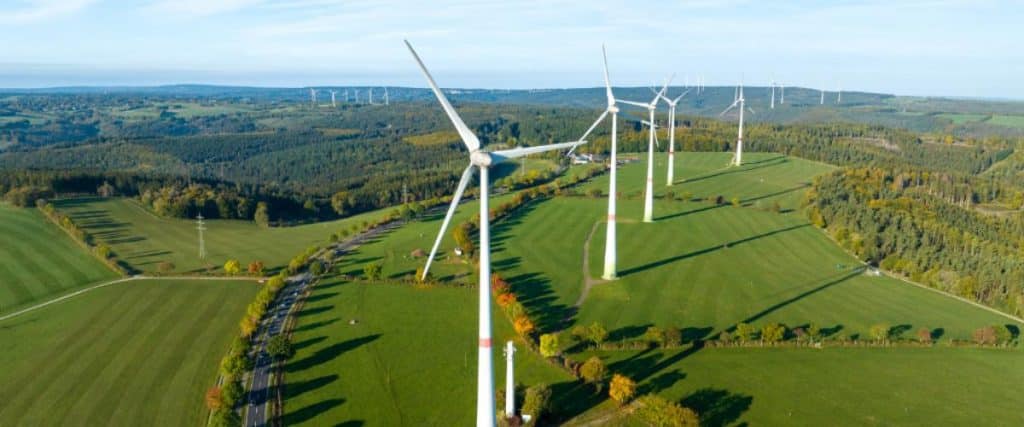
Maintaining wind turbine blades has become a major challenge as wind farms continue to develop all around the world. The challenge is keeping them producing power reliably for two decades or more — and that rely on inspection, condition data, and maintenance plans that actually hold up.
Blades suffer wind loads, rain, temperature swings, lightning strikes, and airborne grit, and they is not kind to a composite surface. A hairline crack or a patch of eroded coating rarely stays small. Left alone, it grows, and what would have been a cheap repair turns into a blade replacement.That's why wind turbine blade inspection has moved from "nice to have" to a core part of asset management for wind farm owners, O&M providers, and the engineering firms that support them. The equipments for inspection it, though, are shifting — and cctv robotic inspection is a big part of why.
Why Blade Condition Deserves More Attention
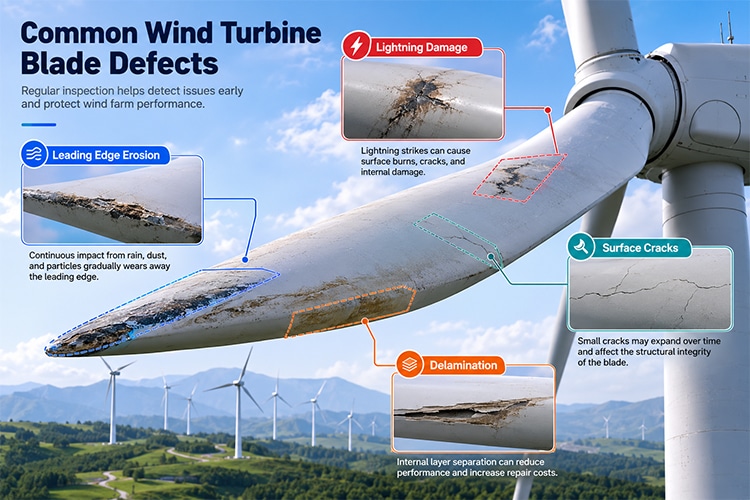
A turbine blade doesn't fail overnight. It degrades gradually, and the damage tends to fall into a few recognizable categories.
Leading edge erosion is probably the most common. The leading edge takes the direct hit from rain and dust at rotor-tip speeds that can exceed 250 km/h, and over thousands of operating hours that erodes the protective coating and slowly reshapes the airfoil. Once the profile changes, aerodynamic efficiency drops — which means lower power output long before anyone notices a mechanical problem.
Lightning stroke and storm damage is another reason, even most blades have equipment protection systems. but it's essential checking the blade after any severe.
Cracking shows up because blades cycle through millions of load reversals over their service life. Micro-cracks and delamination at bonding lines start small and are genuinely cheap to repair — if someone find them early.
None of these problems announce themselves. They're found — or missed — during inspection.
Traditional Inspection Methods
Most wind farms still rely on some combination of rope inspection, drones, and ground visual checks. Each way has a role, but each also has real limits.
Rope access gets technicians close enough to see fine detail, which is its main strength. It's also slow, weather-dependent, and requires trained rope crews plus significant safety preparation — not something you want to schedule across a 200-turbine site more than once or twice a year.
Drones solved the speed problem. A single operator can survey a whole turbine in minutes. But image quality drops off with distance, wind gusts can push a drone off its flight path mid-inspection, and getting truly close-range detail — the kind needed to size a crack accurately — is difficult without risking the equipment or the blade.
Ground-based visual inspection catches the obvious stuff: major surface damage, obvious erosion, visible cracking. It's not built to catch the early-stage defects that matter most for preventive maintenance.
The gap between these methods is exactly where robotic inspection has found its footing.
What Pipe Inspection Robot Changes
A blade inspection robot climbs and moves directly along the blade surface, which means the camera gets the close-range access that rope access provides, without putting a technician at height for hours at a time. The operator runs the inspection from the ground, watching live footage and flagging anything that needs a closer look.
Image detail is consistent and close-range, rather than varying with flight distance or wind conditions.
Every inspection can real time transmission images and videos — footage and stills tied to a specific blade and date — so this year's inspection can be compared directly against last year's.
For an operator managing dozens or hundreds of Wind turbines,this is very important. A single inspection tells you the current state of a blade. A history of inspections tells you how fast it's degrading — and that's what actually drives a repair schedule.
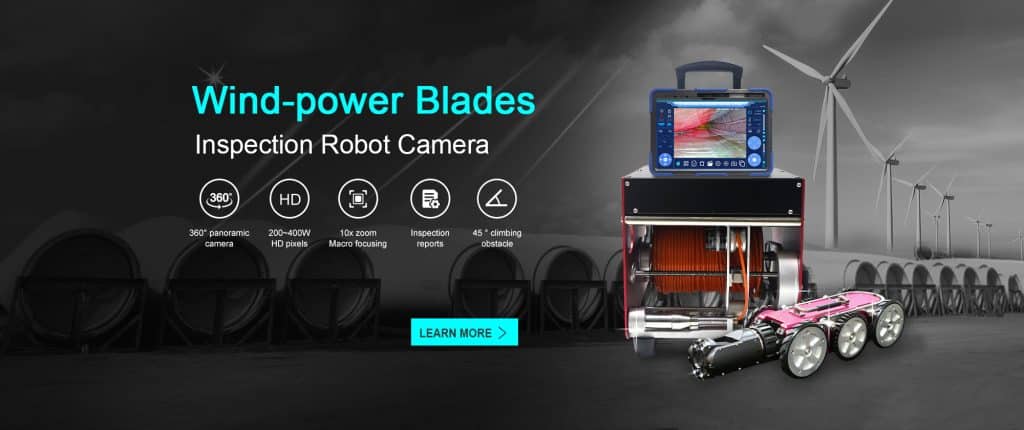
Jiutai GT400 Wind Turbine Blade Inspection Robot
The GT400 Wind Turbine Blade Inspection Robot is built specifically for this job. It's used for routine blade surveys, post-storm damage checks, lightning-strike assessment, and general surface condition evaluation across wind farm sites.
Some things stand out about it:
Stable movement on the blade surface. The GT400 wind turbine blade inspection camera system is designed to hold a controlled, consistent path along the blade during inspection, rather than relying on a stabilized hover the way a drone does.
4MP High-definition imaging. The onboard camera is sharp enough to pick up fine surface defects — the kind that's easy to miss from a distance — and record them clearly for the maintenance file.
Lower risk profile. Because it removes most of the need for technicians to work at height, it directly reduces one of the most persistent safety risks in blade maintenance programs.
Offer inspection report system. Every inspection will one click generates inspection report, compared, and referenced when Formulate maintenance plan.
For wind farm owners, O&M companies, and engineering contractors, the GT400 wind turbine blade inspection robot is a practical way to get more consistent inspection data without expanding the rope-access budget.
Blade Inspection Is Only A Part
Blades get most of the attention because they're visible and directly tied to power output, but they're not the only asset that needs regular inspection. Underground infrastructure — drainage systems, cable conduits, utility pipelines — supports the same wind farm and needs the same kind of proactive checking.
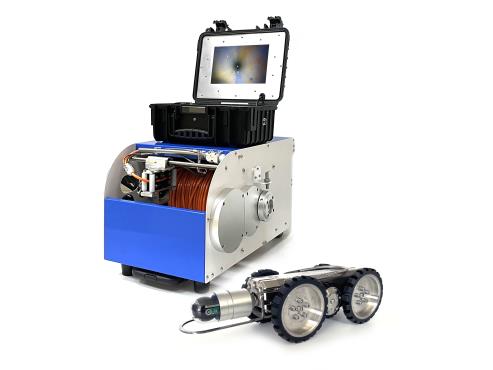
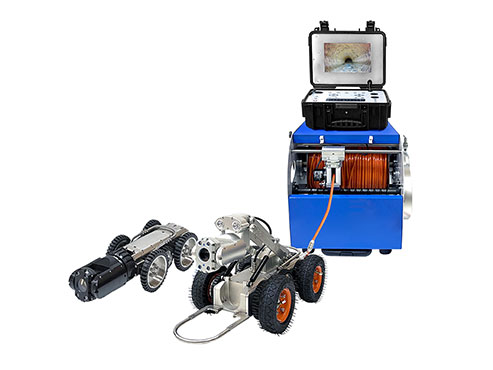
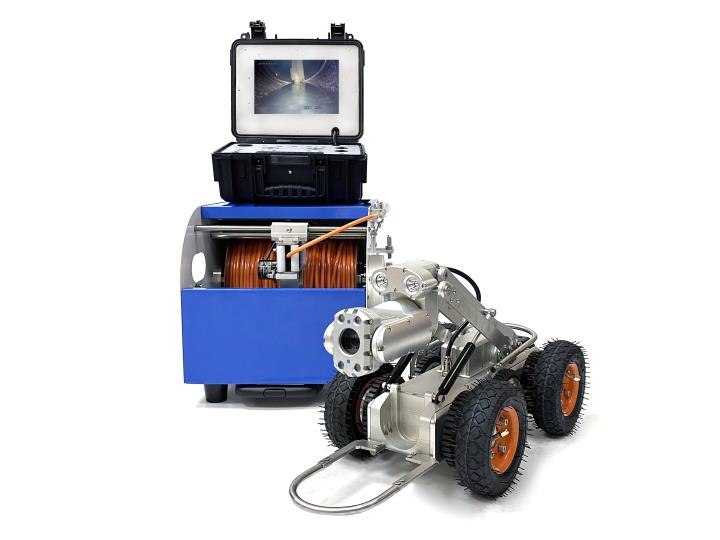
For that, robotic pipeline inspection tools like the GT108 Robotic Pipe Inspection System let maintenance teams inspect underground assets without digging anything up. Pairing blade inspection with infrastructure inspection gives operators a fuller picture of site condition, rather than just the parts that are easiest to see.
Conclusion
Blade condition has a direct line to both energy output and long-term maintenance cost, which is why regular wind turbine blade inspection is worth the investment. Robotic inspection doesn't replace judgment or experience — but it does give maintenance teams correct data, faster, with less risk to the people collecting it.
As wind capacity keeps growing worldwide, blade inspection robots are likely to become standard equipment for any operator serious about extending asset life and avoiding surprise downtime.
Looking for realiable cctv pipeline Inspection solution?
Jiutai Technology specially design robotic inspection systems for wind turbine blades. The GT400 Wind Turbine Blade Inspection Robot helps operators inspect more efficiently, work more safely, and build maintenance records they can actually rely on.
If you manage a wind farm, provide O&M services, or support renewable energy projects, get in touch — our team can recommend the right inspection setup for your site.